Góis Trout Cycle

Monteira Park

The Project

Located in the village of Monteira, in the parish of Vila Nova do Ceira, this municipal facility is designed to showcase the region’s fauna and flora, contributing to its cultural, natural, educational, and sporting enrichment. Special attention is given to the brown trout (Salmo trutta fario), with tanks having been constructed for the breeding of this species. The aim is to revitalise the fish population density of the River Sótão, one of the tributaries of the River Ceira.

The exhibition space, co-financed by Turismo de Portugal IP through the Valorizar Programme, under the measure Touristic Enhancement of the Interior, opened to the public on 10 August 2024, enhancing the educational and touristic offer centred on the natural, cultural, and historical heritage of the municipality. The outdoor area of the Góis Trout Cycle – Monteira Park has also been redeveloped to better welcome visitors, allowing the visit to be complemented with environmental interpretation activities (including the trout tanks and a garden of aromatic herbs) and a small picnic area.

Message from the Mayor

It is with great satisfaction that we present the Góis Trout Cycle – Monteira Park, a project that reflects our commitment to valuing the municipality’s natural, environmental, and cultural heritage. This interpretative space strengthens Góis’ position as a prime destination for nature tourism, fostering knowledge about the brown trout and raising awareness of the importance of preserving our water resources and river ecosystems.

We believe that this facility, co-financed by Turismo de Portugal through the Valorizar Programme, will contribute significantly to the sustainable development of the region, creating educational, scientific, and touristic opportunities, always in harmony with the unique identity that characterises us.

I invite everyone to visit this space and to discover the beauty, history, and vitality that the Parque da Monteira has to offer.

António Rui de Sousa Godinho Sampaio

Mayor of Góis

Ceira Valley

The Ceira Valley is a legacy of great significance, uniquely representing the historic relationship between humankind and nature, here embodied by the river. It is distinguished by a remarkable variety and multiplicity of hydrographic basins, albeit elementary, with watercourses of torrential or winter regime.


The use of water as a source of hydraulic energy has long been a necessity for Humankind, enabling the operation of ancestral work mechanisms upon which survival once depended. An example of this can be seen along the riverbanks, where various water-powered structures remain, such as mills, olive presses, weirs, among others.

This park was established with the aim of creating, in Góis, a hatchery for the breeding of trout, to be released for recreational fishing in the local concessions, while also establishing an educational link with the local community by enabling guided visits to the facilities.

1.Blue Flag Award 2025

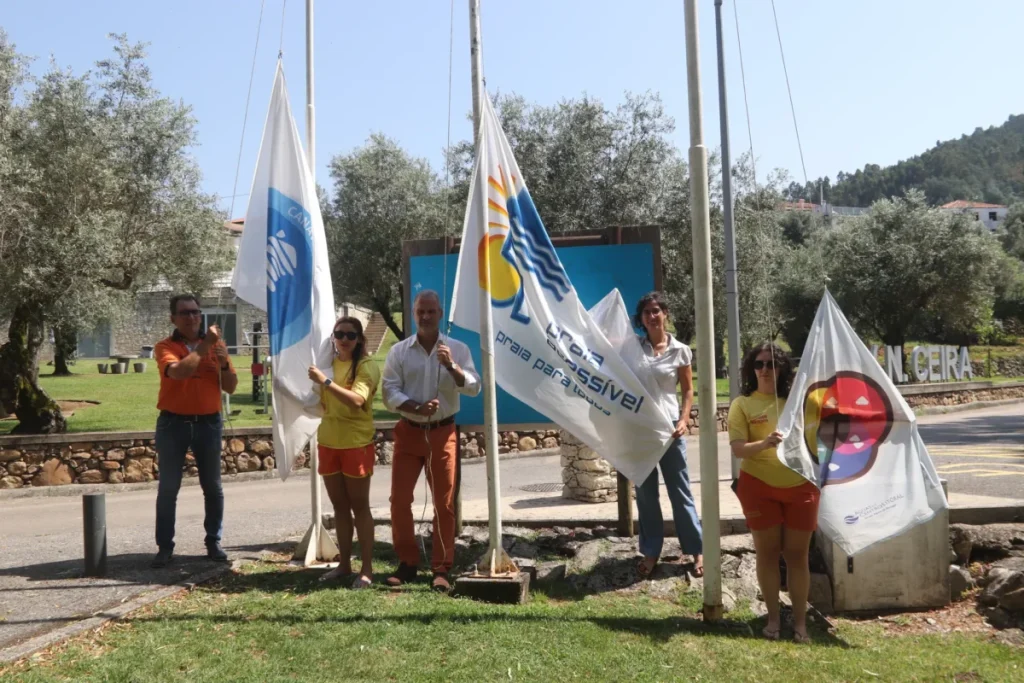
The Blue Flag Programme, represented in Portugal by the Blue Flag Association for Environment and Education (ABAAE), is an initiative of the Foundation for Environmental Education (FEE), a non-governmental organisation supported by the European Commission.
In partnership with several entities, the Municipality of Góis is promoting a set of eight Environmental Education Activities (EEA), under the annual theme “Nature Restoration”.

A competition aimed at promoting environmental awareness and responsibility through a recreational activity that encourages active community participation.

An initiative designed to raise awareness among the general population through articles in the local newspaper, contributions on the radio, and posts on social media.

This workshop seeks to promote ecological and social literacy among pupils and teachers, raising awareness of environmental issues, particularly those relating to nature, with a special focus on terrestrial and aquatic biodiversity.

An activity that brings together people who not only discover the joy and health benefits of walking but also seek to keep their surroundings cleaner as they go.

Workshops designed to encourage social interaction, promote meaningful and healthy leisure, enhance participants’ self-esteem, and provide opportunities for new knowledge and lifelong learning.

Linked to the celebrations of Youth Day, this activity combines sport, traditional games, leisure, and entertainment with an environmental theme. It aims to promote sport alongside the adoption of environmentally friendly practices.

A training initiative based on the annual theme “Nature Restoration”, encouraging active citizenship and alignment with the UN’s Sustainable Development Goals (SDGs). It is aimed at young leaders who play an important role in spreading this message among their peers through their own initiatives.

This initiative brings together people who, while enjoying the benefits of walking, also contribute to cleaning their municipality. Its focus is on the collection of discarded cigarette butts, helping to improve the local environment.

Within its cultural programming, the Municipality has sought to link local development, the circular economy, and traditional practices.


The dynamics of the tourism sector, particularly through local businesses in the catering industry, have enabled the promotion and dissemination of Trout as a product of excellence. In this regard, the project aims to create specimens that will be offered, free of charge, to local restaurants so that Trout may be incorporated into their menus. Examples of such initiatives include the Trout Festival, Easter of Flavours, and the Taste Coimbra Region Menu (an inter-municipal project).

Canyoning

Gastronomy

Olive Oil Mills

Legends and Stories

Mills

Routes

Fishing

Traditions and Customs

Monteira Park

Monteira Park occupies a total area of 2 500 m², of which approximately 2 354 m² are green spaces, 85m² correspond to the building, and 62 m² to five outdoor tanks.
The park was established with the aim of creating, in Góis, a hatchery dedicated to the production of trout for release in sport fishing concessions within the municipality, while also fostering an educational relationship with the local community by providing guided visits to the facilities.

The Góis Hatchery was created to support the preservation of local freshwater fish species, particularly the brown trout (Salmo trutta fario). This facility operates as an incubation laboratory, where artificial fertilisation, egg incubation, growth, and rearing of fry (young fish) take place, thereby ensuring the natural restocking of rivers and sport fishing concessions.

Eggs are acquired from the ICNF (Institute for Nature Conservation and Forests) or, with proper authorisation, collected from specimens captured in local watercourses. They are incubated in open-circuit glass tanks, where they remain until they reach approximately 3 cm in length. They are then transferred to the outdoor tanks, where they continue to grow until they are ready to be released into the rivers.

The five outdoor tanks are installed below ground level, constructed from prefabricated circular concrete elements measuring 3 metres in depth and 2 metres in diameter, with a water height of 2.40 metres and a reservoir volume of 0.26 m³, resulting in a total depth of 3.00 metres. This installation was designed to address the supply of running water from two wells, with a level difference of 2 metres, allowing continuous distribution of water to the outdoor tanks and to the glass aquarium where the fry develop inside the building.

The supply of running water to the tanks is conducted simultaneously across all tanks, preventing cross-contamination between them.

The building was constructed to support the tanks and the park’s visitors. Functionally, it is developed on a single floor and is divided into three areas. The first area is dedicated to the exhibition space. The second area comprises the section housing the hatchery and the storage for fish feed and cleaning equipment for the outdoor tanks. The third area accommodates the restrooms serving both the building and the park.

The building is situated on flat, elevated ground to prevent soil impermeabilisation and to protect the structure against potential flooding.

The Trout Cycle of Góis – Monteira Park, composed of the exhibition space and its associated tanks, is surrounded by landscaped grounds that provide an ideal setting for small groups, particularly for picnics. This area also represents an excellent resource for promoting outdoor environmental education activities, such as storytelling, traditional games, reading sessions, and landscape interpretation.

On the left-hand side lies the “Herb Corner”, a small garden with unique educational potential, featuring plants rooted in the traditions and ethnobotanical heritage of the municipality. These are associated with legends, mysticism, gastronomy, and the treatment of ailments.

Exhibition

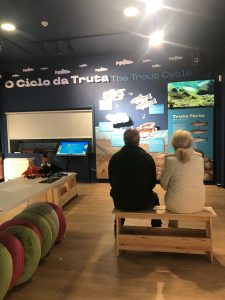
The exhibition space, designed to enrich the educational and touristic offer of the municipality, features interactive touch kiosks, descriptive videos, virtual reality, and educational games. These explore four thematic areas:

Merchandise

100% Cotton Cloth Bag, Navy Blue

Pencil with eraser

A5 notepad, navy blue cover

The exhibition space, designed to enrich the educational and touristic offer of the municipality, features interactive touch kiosks, descriptive videos, virtual reality, and educational games. These explore four thematic areas:

Merchandise

100% Cotton Cloth Bag, Navy Blue

Pencil with eraser

A5 notepad, navy blue cover

Activities

Educational Programme

This programme aims to engage visitors at the Trout Life Cycle of Góis – Monteira Park in an inclusive and educational manner, strengthening community bonds and increasing knowledge of the municipality’s natural and cultural heritage.

Practical organisation:

Scheduling: contact the Tourist Office for group visits outside weekends.
Required materials: magnifying glasses, binoculars, toy fishing rods, paper, pencils/pens, planting materials.
Logistics: adequate supervision by educators/technicians, assistance for elderly participants.
Assessment:

  • Pre-school: drawing and participation
  • Primary school: diagrams and graphic records
  • Seniors: sharing memories and personal reflections

Available Activities

Objective: spark curiosity about aquatic ecosystems and the trout as a local symbol.

  1. Welcome circle: tell a short story about the Ceira trout using puppets.
  2. Interactive video: watch a video about the Water Cycle followed by simple questions (“What is water used for?”).
  3. Virtual reality: explore the river and habitats, enhancing sensory perception.
  4. Tank observation: use magnifying glasses to examine brown trout and fry.
  5. Fishing game: use toy rods to “catch” paper fish—reinforcing turns, rules, and teamwork.
  6. Free drawing: paint trout and river landscapes.
  7. Storytelling with official mascots.

Objective: deepen scientific, geographical, and environmental understanding.

  1. Guided introduction: read the informational panels (Water Cycle and Ceira Valley).
  2. Challenge “From River to Plate”: explain the water journey to the trout using an interactive map.
  3. Scientific drawing: record the trout’s life cycle using diagrams and arrows.
  4. Video and analysis: compare different developmental stages of the trout.
  5. Outdoor activity: fishing game with clear rules and recording results in a bar chart.
  6. Brief reflection: questions such as “How can we protect the river and the trout?” and “Why is clean water important?”
    Estimated duration: 2 hours 30 minutes
  7. “Night with the Trout” (limited participants)
    An educational nocturnal experience at Monteira Park


Educational objectives:

  • Stimulate autonomy and scientific observation.
  • Develop fieldwork and documentation skills.

Objective: promote active learning, shared memories, and social interaction.

  1. Leisurely guided visit: slow reading of the panels on Man and the River, local stories, and collective memory (linked to traditional fishing activities).
  2. Trout observation: using portable binoculars, discuss changes in the river over time.
  3. Shared memories: group conversation about personal fishing experiences at the Ceira River and local trout recipes (“Ceira-style trout”).
  4. Short interpretative walk: explore the surrounding area, identifying riparian flora.
  5. Hands-on activity: plant small native plants along the river (seeds or saplings), reinforcing connection to the ecosystem.
  6. Community snack: share local treats (bread, cheese, honey), encouraging social interaction.
    Estimated duration: 2 hours
News
Contacts

[Third weekend of each month]


Saturday and Sunday
2:30 pm – 5:30 pm


[Free entry | Due to the limited exhibition space, each visit can accommodate a maximum of 10 people]

Duration of each visit:* 45 minutes

Trout Cycle of Góis
Monteira Park

An interpretative, accessible, and inclusive space designed to enrich the educational and tourist offerings related to the natural, cultural, and historical heritage of the municipality.

For further information, to book visits, or to schedule educational activities, please contact the Municipal Tourist Office – Tl. +351 235 770 113 or e-mail turismo@cm-gois.pt

Email: correio@cm-gois.pt

Telephone: +351 235 770 110

Responsible department: Tourism and Cultural Action Service

How to Reach Monteira Park

Location: Monteira Village, Parish of Vila Nova do Ceira

GPS Coordinates: 40° 9′ 58.633″ N, 8° 8′ 50.464″ W

Góis Trout Cycle

Monteira Park

The Project

Located in the village of Monteira, in the parish of Vila Nova do Ceira, this municipal facility is designed to showcase the region’s fauna and flora, contributing to its cultural, natural, educational, and sporting enrichment. Special attention is given to the brown trout (Salmo trutta fario), with tanks having been constructed for the breeding of this species. The aim is to revitalise the fish population density of the River Sótão, one of the tributaries of the River Ceira.

The exhibition space, co-financed by Turismo de Portugal IP through the Valorizar Programme, under the measure Touristic Enhancement of the Interior, opened to the public on 10 August 2024, enhancing the educational and touristic offer centred on the natural, cultural, and historical heritage of the municipality. The outdoor area of the Góis Trout Cycle – Monteira Park has also been redeveloped to better welcome visitors, allowing the visit to be complemented with environmental interpretation activities (including the trout tanks and a garden of aromatic herbs) and a small picnic area.

Message from the Mayor

It is with great satisfaction that we present the Góis Trout Cycle – Monteira Park, a project that reflects our commitment to valuing the municipality’s natural, environmental, and cultural heritage. This interpretative space strengthens Góis’ position as a prime destination for nature tourism, fostering knowledge about the brown trout and raising awareness of the importance of preserving our water resources and river ecosystems.

We believe that this facility, co-financed by Turismo de Portugal through the Valorizar Programme, will contribute significantly to the sustainable development of the region, creating educational, scientific, and touristic opportunities, always in harmony with the unique identity that characterises us.

I invite everyone to visit this space and to discover the beauty, history, and vitality that the Parque da Monteira has to offer.

António Rui de Sousa Godinho Sampaio

Mayor of Góis

Ceira Valley

The Ceira Valley is a legacy of great significance, uniquely representing the historic relationship between humankind and nature, here embodied by the river. It is distinguished by a remarkable variety and multiplicity of hydrographic basins, albeit elementary, with watercourses of torrential or winter regime.

The use of water as a source of hydraulic energy has long been a necessity for Humankind, enabling the operation of ancestral work mechanisms upon which survival once depended. An example of this can be seen along the riverbanks, where various water-powered structures remain, such as mills, olive presses, weirs, among others.

This park was established with the aim of creating, in Góis, a hatchery for the breeding of trout, to be released for recreational fishing in the local concessions, while also establishing an educational link with the local community by enabling guided visits to the facilities.

1. Blue Flag Award 2025

The Blue Flag Programme, represented in Portugal by the Blue Flag Association for Environment and Education (ABAAE), is an initiative of the Foundation for Environmental Education (FEE), a non-governmental organisation supported by the European Commission.
In partnership with several entities, the Municipality of Góis is promoting a set of eight Environmental Education Activities (EEA), under the annual theme “Nature Restoration”.

A competition aimed at promoting environmental awareness and responsibility through a recreational activity that encourages active community participation.

An initiative designed to raise awareness among the general population through articles in the local newspaper, contributions on the radio, and posts on social media.

This workshop seeks to promote ecological and social literacy among pupils and teachers, raising awareness of environmental issues, particularly those relating to nature, with a special focus on terrestrial and aquatic biodiversity.

An activity that brings together people who not only discover the joy and health benefits of walking but also seek to keep their surroundings cleaner as they go.

Workshops designed to encourage social interaction, promote meaningful and healthy leisure, enhance participants’ self-esteem, and provide opportunities for new knowledge and lifelong learning.

Linked to the celebrations of Youth Day, this activity combines sport, traditional games, leisure, and entertainment with an environmental theme. It aims to promote sport alongside the adoption of environmentally friendly practices.

A training initiative based on the annual theme “Nature Restoration”, encouraging active citizenship and alignment with the UN’s Sustainable Development Goals (SDGs). It is aimed at young leaders who play an important role in spreading this message among their peers through their own initiatives.

This initiative brings together people who, while enjoying the benefits of walking, also contribute to cleaning their municipality. Its focus is on the collection of discarded cigarette butts, helping to improve the local environment.

Within its cultural programming, the Municipality has sought to link local development, the circular economy, and traditional practices.

The dynamics of the tourism sector, particularly through local businesses in the catering industry, have enabled the promotion and dissemination of Trout as a product of excellence. In this regard, the project aims to create specimens that will be offered, free of charge, to local restaurants so that Trout may be incorporated into their menus. Examples of such initiatives include the Trout Festival, Easter of Flavours, and the Taste Coimbra Region Menu (an inter-municipal project).

Canyoning

Gastronomy

Olive Oil Mills

Legends and Stories

Mills

Routes

Fishing

Traditions and Customs

Monteira Park

Monteira Park occupies a total area of 2 500m², of which approximately 2 354 m² are green spaces, 85m² correspond to the building, and 62m² to five outdoor tanks.
The park was established with the aim of creating, in Góis, a hatchery dedicated to the production of trout for release in sport fishing concessions within the municipality, while also fostering an educational relationship with the local community by providing guided visits to the facilities.

The Góis Hatchery was created to support the preservation of local freshwater fish species, particularly the brown trout (Salmo trutta fario). This facility operates as an incubation laboratory, where artificial fertilisation, egg incubation, growth, and rearing of fry (young fish) take place, thereby ensuring the natural restocking of rivers and sport fishing concessions.
Eggs are acquired from the ICNF (Institute for Nature Conservation and Forests) or, with proper authorisation, collected from specimens captured in local watercourses. They are incubated in open-circuit glass tanks, where they remain until they reach approximately 3 cm in length. They are then transferred to the outdoor tanks, where they continue to grow until they are ready to be released into the rivers.

The five outdoor tanks are installed below ground level, constructed from prefabricated circular concrete elements measuring 3 metres in depth and 2 metres in diameter, with a water height of 2.40 metres and a reservoir volume of 0.26 m³, resulting in a total depth of 3.00 metres. This installation was designed to address the supply of running water from two wells, with a level difference of 2 metres, allowing continuous distribution of water to the outdoor tanks and to the glass aquarium where the fry develop inside the building.

The supply of running water to the tanks is conducted simultaneously across all tanks, preventing cross-contamination between them.

The building was constructed to support the tanks and the park’s visitors. Functionally, it is developed on a single floor and is divided into three areas. The first area is dedicated to the exhibition space. The second area comprises the section housing the hatchery and the storage for fish feed and cleaning equipment for the outdoor tanks. The third area accommodates the restrooms serving both the building and the park.

The building is situated on flat, elevated ground to prevent soil impermeabilisation and to protect the structure against potential flooding.

The Trout Cycle of Góis – Monteira Park, composed of the exhibition space and its associated tanks, is surrounded by landscaped grounds that provide an ideal setting for small groups, particularly for picnics. This area also represents an excellent resource for promoting outdoor environmental education activities, such as storytelling, traditional games, reading sessions, and landscape interpretation.
On the left-hand side lies the “Herb Corner”, a small garden with unique educational potential, featuring plants rooted in the traditions and ethnobotanical heritage of the municipality. These are associated with legends, mysticism, gastronomy, and the treatment of ailments.

Exhibition

The exhibition space, designed to enrich the educational and touristic offer of the municipality, features interactive touch kiosks, descriptive videos, virtual reality, and educational games. These explore four thematic areas:

Merchandise

100% Cotton Cloth Bag, Navy Blue

Pencil with eraser

A5 notepad, navy blue cover

Activities

Educational Programme

This programme aims to engage visitors at the Trout Life Cycle of Góis – Monteira Park in an inclusive and educational manner, strengthening community bonds and increasing knowledge of the municipality’s natural and cultural heritage.

Practical organisation:

  • Scheduling: contact the Tourist Office for group visits outside weekends.
  • Required materials: magnifying glasses, binoculars, toy fishing rods, paper, pencils/pens, planting materials.
  • Logistics: adequate supervision by educators/technicians, assistance for elderly participants.
  • Assessment:
    • Pre-school: drawing and participation
    • Primary school: diagrams and graphic records
    • Seniors: sharing memories and personal reflections

Available Activities

Objective:

Spark curiosity about aquatic ecosystems and the trout as a local symbol.

–  Welcome circle: tell a short story about the Ceira trout using puppets.

–  Interactive video: watch a video about the Water Cycle followed by simple questions (“What is water used for?”).

–  Virtual reality: explore the river and habitats, enhancing sensory perception.

–  Tank observation: use magnifying glasses to examine brown trout and fry.

–  Fishing game: use toy rods to “catch” paper fish—reinforcing turns, rules, and teamwork.

–  Free drawing: paint trout and river landscapes.

–  Storytelling with official mascots.

Objective: deepen scientific, geographical, and environmental understanding.

  1. Guided introduction: read the informational panels (Water Cycle and Ceira Valley).
  2. Challenge “From River to Plate”: explain the water journey to the trout using an interactive map.
  3. Scientific drawing: record the trout’s life cycle using diagrams and arrows.
  4. Video and analysis: compare different developmental stages of the trout.
  5. Outdoor activity: fishing game with clear rules and recording results in a bar chart.
  6. Brief reflection: questions such as “How can we protect the river and the trout?” and “Why is clean water important?”
    Estimated duration: 2 hours 30 minutes
  7. “Night with the Trout” (limited participants)
    An educational nocturnal experience at Monteira Park
    Educational objectives:
  • Stimulate autonomy and scientific observation.
  • Develop fieldwork and documentation skills.

Objective: promote active learning, shared memories, and social interaction.

  1. Leisurely guided visit: slow reading of the panels on Man and the River, local stories, and collective memory (linked to traditional fishing activities).
  2. Trout observation: using portable binoculars, discuss changes in the river over time.
  3. Shared memories: group conversation about personal fishing experiences at the Ceira River and local trout recipes (“Ceira-style trout”).
  4. Short interpretative walk: explore the surrounding area, identifying riparian flora.
  5. Hands-on activity: plant small native plants along the river (seeds or saplings), reinforcing connection to the ecosystem.
  6. Community snack: share local treats (bread, cheese, honey), encouraging social interaction.
    Estimated duration: 2 hours

Notícias

Trout Cycle of Góis – Monteira Park

An interpretative, accessible, and inclusive space designed to enrich the educational and tourist offerings related to the natural, cultural, and historical heritage of the municipality.

Note: For further information, to book visits, or to schedule educational activities, please contact the Municipal Tourist Office

Tl. +351 235 770 113

ou

turismo@cm-gois.pt

Email: correio@cm-gois.pt

Telephone: + 351 235 770 110

Responsável: Serviço de Turismo e Ação Cultural

Contacts

Opening Hours:*

[Third weekend of each month]

Saturday and Sunday
2:30 pm – 5:30 pm

[Free entry | Due to the limited exhibition space, each visit can accommodate a maximum of 10 people]

Duration of each visit:* 45 minutes

How to Reach Monteira Park

Location: Monteira Village, Parish of Vila Nova do Ceira

GPS Coordinates: 40° 9′ 58.633″ N, 8° 8′ 50.464″ W

The natural water cycle is an essential process for life on Earth because it allows for the renewal of water and all the biodiversity that depends on it to survive. The water on our planet is always the same, but it is constantly moving and changing state.

This transformation and circulation of water is known as the water cycle, or hydrological cycle, which occurs through the processes of evaporation, evapotranspiration, condensation, precipitation, runoff, and infiltration.

It is through the hydrological cycle that climate variations occur, conditions for human, plant, and animal life are created, and water is purified and circulated through rivers, lakes, and oceans.

This continuous circulation process allows water to change location and physical state countless times.

Evaporation is a phenomenon that occurs when the surface waters of rivers, lakes, and oceans are heated by the sun and change from a liquid to a gaseous state, moving from the Earth’s surface into the atmosphere.

Evapotranspiration is the natural process by which water in vapour form is transferred from the Earth’s surface to the atmosphere. Evapotranspiration includes water from the evaporation of liquid or solid water from the soil and the transpiration of plants that make up the soil’s vegetative cover.

Condensation occurs when water vapour cools and accumulates in the atmosphere, forming tiny droplets that create clouds or fog.

Precipitation happens when the droplets suspended in the air become too heavy and fall to the ground as rain. When these droplets encounter very cold air currents, they change from liquid to solid, forming snow or hail.

When it rains or snows, the water follows its course through surface or underground runoff, or infiltrates the soil, giving rise to aquifers or groundwater.

This circular and infinite movement repeats constantly, with water changing its state depending on the environment it is in.

The Ceira Valley is located between the Açor Mountains (1,340 metres in altitude) and the Lousã Mountains (1,205 metres in altitude). Together with the Serra da Estrela (1,993 metres in altitude), they form the most impressive and important mountain range in Portugal – the Central Range, which crosses the Iberian Meseta in a northeast–southwest direction, dividing it roughly in half.

The region of the Ceira Valley, where the crystal-clear waters of the Ceira River and its tributaries spring forth, is extremely rich in terms of landscape, particularly with regard to its orography.

This territory is characterised by a great variety and multiplicity of hydrographic basins, with watercourses of a torrential or winter regime. “The high frequency of watercourses and their characteristic torrential nature result from the considerable levels of rainfall in the Lousã and Açor mountains, which form an obstacle to the passage of air masses, as well as from the presence of thin soils, sparse vegetation, and steep slopes.”

The Ceira Valley “presents a considerable diversity of ecological structures, induced by notable variations in geomorphology, soil, and climate, which give rise to numerous habitats and species of conservation interest. The presence of combisols of schist and greywacke, due to the slow degradation of the parent rock, and of fluvisols, being thick alluvial soils, means that this is a fertile territory.”

Along the river, there are traces of ancient human occupation, with hydraulic works and infrastructures such as watermills, olive presses, irrigation channels, and a water-powered sawmill, among others.

The Ceira River is a Portuguese river that rises in the Açor Mountains, specifically at Cabeço do Gondufo, at an altitude of 1,302 metres. It flows through the municipalities of Arganil and Pampilhosa da Serra, passing through the municipalities of Góis, Lousã, and Miranda do Corvo.

Within the municipality of Góis, the Ceira River extends for 33 kilometres, from the Union of Parishes of Cadafaz and Colmeal (near the village of Soito), passing through the parish of Góis, and ending its course in the parish of Vila Nova do Ceira, in the locality of Cabril.

The Ceira River flows into the Mondego River near Portela, in the municipality of Coimbra, joining it as a left-bank (southern) tributary. The Ceira is one of the main direct tributaries of the Mondego River. The Ceira River basin covers an area of 735 km², and the river itself has a total length of approximately 106 kilometres.

The landscape is characterised by valleys with a “V” profile (particularly upstream of the town of Góis), formed by intense erosion caused by rainfall and numerous watercourses.

In general terms, the stretch between the river’s source and the vicinity of Góis corresponds to areas of higher altitude and steeper slopes. Conversely, downstream from the “Candosa fluvial canyon”, the slopes become generally gentler — a condition that continues all the way to the Ceira River’s mouth.

The adult trout is territorial – it lives in flowing, well-oxygenated, clear, and cool waters. For this reason, it seeks out rivers with good water quality. It is a species highly sensitive to pollution, particularly residues from pesticides and herbicides used by many farmers, as well as to high temperatures.


The adult brown trout is very voracious. It feeds on invertebrates, aquatic insect larvae, and small fish. It hides from predators in the deeper parts of the river.


In winter, they migrate upstream to spawn. Brown trout can live between 5 and 20 years. Salmonid pairs are rarely alone in their spawning sites, as competition is intense. Males fiercely compete for the opportunity to fertilise a spawning site and defend their reproductive territory. Females also compete for spawning areas.


At Parque da Monteira, the trout are fed on diets designed to cover their entire growth cycle, meeting the nutritional needs of the fish from juvenile to adult stages.

O ciclo natural da água é um processo essencial para a vida no planeta Terra porque permite a renovação de água e de toda a biodiversidade que dela depende para viver. A água existente no nosso planeta é sempre a mesma, mas está sempre a mudar de lugar e de estado.

A esta transformação e circulação da água dá-se o nome de ciclo da água ou ciclo hidrológico, que se desenvolve através dos processos de evaporação, evapotranspiração, condensação, precipitação, escoamento e infiltração.

É através do Ciclo Hidrológico que se dão as variações climáticas, a criação de condições para a vida do homem, das plantas e dos outros animais, a purificação e a circulação de água nos rios, lagos e oceanos.

Este processo de circulação permanente permite que a água mude de lugar e de estado físico uma infinidade de vezes.

A evaporação é um fenómeno que ocorre quando as águas superficiais dos rios, lagos e oceanos aquecem por ação do sol e passam do estado líquido para o estado gasoso, deslocando-se da superfície terrestre para a atmosfera.

A evapotranspiração é o processo de transferência natural da água, no estado de vapor, da superfície da Terra para a atmosfera. A evapotranspiração inclui a água proveniente da evaporação da água, no estado líquido ou sólido, do solo, e da transpiração das plantas que constituem o revestimento vegetal do solo.

A condensação dá-se quando o vapor de água arrefece e se acumula na atmosfera dando origem a pequenas gotas criando as nuvens ou nevoeiros. 

A precipitação ocorre quando as gotas suspensas no ar se tornam demasiado pesadas e caem no solo sob a forma de chuva. Quando estas gotas são acompanhadas de correntes de ar muito frias passam do estado líquido para o estado sólido formando neve ou granizo. 

Quando chove ou neva, a água toma o seu curso através do escoamento superficial ou subterrâneo ou infiltra-se na terra, dando origem aos lençóis freáticos ou águas subterrâneas

Este movimento circular e infinito, repete-se constantemente, alterando o seu estado de cordo com o espaço onde se encontra.

O Vale do Ceira localiza-se entre as Serras do Açor (1.340 metros de altitude) e da Lousã (1.205 metros de altitude). Em conjunto com a Serra da Estrela (1.993 metros de altitude) formam o mais imponente e importante alinhamento montanhoso de Portugal – a Cordilheira Central que atravessa a Meseta Ibérica no sentido nordeste-sudoeste dividindo-a sensivelmente a meio.

A região do vale do Ceira, na qual nascem as águas cristalinas do rio Ceira e dos seus efluentes, é extremamente rica a nível paisagístico, nomeadamente em termos de orografia.

Este território caracteriza-se por uma grande variedade e multiplicidade de bacias hidrográficas, com cursos de água de regime torrencial ou invernoso. “A elevada frequência de cursos de água e o seu característico regime torrencial resultam da existência de valores de pluviosidade bastante elevados nas serras da Lousã e do Açor, que formam um obstáculo à passagem das massas de ar, assim como de solos pouco espessos, de vegetação pobre e da presença de declives acentuados.”

O vale do Ceira “apresenta uma considerável diversidade de estruturas ecológicas induzida por variações assinaláveis ao nível da geomorfologia, dos solos e do clima, que se traduz pela presença de inúmeros habitats e espécies com interesse conservacionista. A presença de combissolos de xistos e grauvaques, devido à lenta degradação da rocha-mãe e de fluvissolos, por serem solos aluvionares espessos o que significa que este é um território fértil.

Ao longo do rio existem, vestígios de uma ancestral ocupação humana com obras e infraestruturas de aproveitamento hidráulico como são exemplo os moinhos, os lagares de azeite, as levadas, a serração movida a energia hídrica, entre outras.

O rio Ceira é um rio português que nasce na Serra do Açor, mais concretamente no Cabeço do Gondufo, a uma cota de 1.302 metros de altitude, atravessando os concelhos de Arganil e Pampilhosa da Serra, passando pelo concelho de Góis, Lousã e Miranda do Corvo.

No concelho de Góis, o rio Ceira tem uma extensão de 33 quilómetros, desde a União de Freguesias de Cadafaz e Colmeal (junto à aldeia do Soito), passando pela freguesia de Góis, terminando a suasai passagem na freguesia da Vila Nova do Ceira, no lugar de Cabril.

O rio Ceira desagua nas proximidades da Portela, concelho de Coimbra, no rio Mondego afluente da margem esquerda (sul) do rio. O rio Ceira é um dos principais afluentes diretos do rio Mondego. A bacia hidrográfica do rio Ceira tem uma área de 735 km2 e, o comprimento desta linha de água é de cerca de 106 quilómetros.

A paisagem encontra-se marcada por vales que apresentam perfil em “V” (sobretudo a montante da vila de Góis), fruto da erosão intensa provocada pelas chuvas e pelos inúmeros cursos de água.


De uma forma geral, o troço entre a nascente e até às proximidades de Góis corresponde as áreas de maior altitude e de declives mais acentuados. Por outro lado, a jusante do “canhão fluvial da Candosa” os declives são, no geral, mais suaves, situação que se prolonga até à foz do rio Ceira.

A truta adulta é territorial – vive em águas correntes, bem oxigenadas, límpidas e frescas. Por isso procura rios com boa qualidade da água. É uma espécie muito sensível à poluição, nomeadamente aos resíduos de pesticidas e herbicidas utilizados por muitos agricultores e a temperaturas elevadas.


A truta fário adulta é muito voraz. Alimenta-se de invertebrados, larvas de insetos aquáticos e pequenos peixes. Esconde-se dos predadores nas zonas mais profundas do rio.


No inverno migram rio acima para desovar. A truta fário pode viver entre os 5 a 20 anos.
Os casais de salmonídeos raramente estão sozinhos nos locais de postura sendo que a competição é intensa. Os machos disputam intensamente a possibilidade de fecundarem uma postura e defendem o território de reprodução. As fêmeas também competem pelas áreas de postura.


No Parque da Monteira, a alimentação das trutas é realizada à base de receitas que cobrem todo o ciclo de crescimento, satisfazendo as necessidades nutricionais dos peixes da fase juvenil à fase adulta.